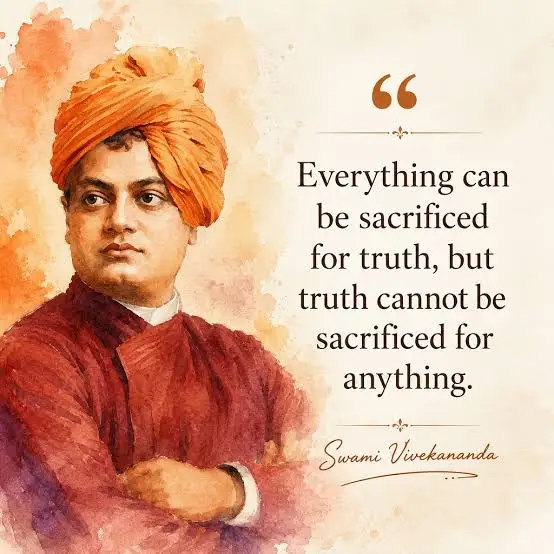
Swami Vivekananda: The Spiritual Visionary Who Awakened India’s Soul
India has been blessed with many great philosophers, saints, and reformers whose teachings have inspired humanity for centuries. Among these towering personalities, Swami Vivekananda occupies a unique and unforgettable place. A monk, philosopher, patriot, social reformer, and one of the greatest spiritual ambassadors of India, Vivekananda dedicated his life to spreading the timeless wisdom of Indian philosophy and awakening the inner strength of humanity. His powerful speeches, profound ideas, and unwavering faith in the potential of every individual continue to inspire millions across the world.
Swami Vivekananda was born as Narendranath Datta on 12 January 1863 in Kolkata (then Calcutta), West Bengal. He was born into a cultured and educated Bengali family. His father, Vishwanath Datta, was a successful lawyer known for his rational thinking and broad outlook, while his mother, Bhuvaneshwari Devi, was a deeply religious woman whose stories from the Ramayana and Mahabharata left a lasting impression on young Narendra. From childhood, he displayed extraordinary intelligence, a remarkable memory, and an insatiable curiosity. Unlike many children of his age, he constantly questioned accepted beliefs and sought logical explanations for religious and philosophical ideas.
Narendra excelled in his studies and developed interests in literature, music, philosophy, history, and physical fitness. He was an avid reader and absorbed knowledge from both Indian scriptures and Western philosophy. Yet, despite his academic brilliance, he remained deeply troubled by one fundamental question: “Has anyone seen God?” This sincere spiritual quest eventually led him to Sri Ramakrishna Paramahansa, the saint of Dakshineswar. When Narendra asked him the same question, Sri Ramakrishna replied with complete conviction, “Yes, I have seen God as clearly as I see you.” This simple yet profound answer transformed Narendra’s life.
Initially skeptical, Narendra gradually became one of Sri Ramakrishna’s closest disciples. Under his master’s guidance, he realized that spirituality was not merely about rituals or religious ceremonies but about experiencing the divine within oneself and serving humanity with love and compassion. Sri Ramakrishna taught him that all religions ultimately lead to the same truth and that selfless service to mankind is the highest form of worship. These teachings became the foundation of Vivekananda’s philosophy and later shaped his mission across India and the world.
After the passing of Sri Ramakrishna in 1886, Narendra embraced monastic life and took the name Swami Vivekananda. He travelled extensively throughout India as a wandering monk, witnessing firsthand the country’s immense cultural richness as well as the widespread poverty, ignorance, and social inequality that afflicted millions of people. These journeys profoundly influenced his vision for India’s future. He believed that the true strength of the nation lay not merely in its ancient spiritual heritage but also in the upliftment of its people through education, character-building, and social service.
The defining moment of Swami Vivekananda’s life came in 1893, when he represented Hinduism at the Parliament of the World’s Religions in Chicago, USA. On 11 September 1893, he began his speech with the now-famous words, “Sisters and Brothers of America.” The warmth, sincerity, and universal spirit of this greeting earned him a standing ovation that lasted several minutes. His speech introduced the world to India’s spiritual heritage, emphasizing tolerance, harmony, and respect for all religions. He declared that religious diversity should never become a cause of conflict but should instead be celebrated as different paths leading to the same ultimate truth.
Vivekananda’s remarkable speeches in America and Europe earned him worldwide recognition. He challenged misconceptions about India and presented Vedanta philosophy in a language that appealed to modern minds. He demonstrated that spirituality was compatible with science, reason, and progress. Through his lectures, he inspired people to cultivate inner strength, self-confidence, discipline, and compassion. His message transcended religious boundaries and emphasized the unity of humanity.
Upon returning to India in 1897, Swami Vivekananda received a hero’s welcome. Thousands gathered to hear him speak about national awakening, education, and social reform. He reminded Indians that they should take pride in their cultural heritage while embracing scientific knowledge and modern education. He firmly believed that no nation could progress if its people lacked confidence in themselves. One of his most famous teachings was, “Arise, awake, and stop not till the goal is reached.” These words continue to motivate students, professionals, entrepreneurs, and leaders around the world.
In the same year, he founded the Ramakrishna Mission, an organization dedicated to education, healthcare, disaster relief, rural development, and spiritual growth. The Mission embodied his philosophy of “Service to man is service to God.” Unlike many religious organizations that focused solely on rituals, the Ramakrishna Mission actively engaged in humanitarian work, establishing schools, colleges, hospitals, libraries, and charitable institutions. Even today, the Mission continues to serve society across India and many other countries.
Swami Vivekananda considered education to be the most powerful tool for transforming individuals and nations. However, he believed that education should go beyond textbooks and examinations. According to him, true education is “the manifestation of the perfection already within man.” He emphasized character-building, moral values, self-discipline, courage, and independent thinking. He wanted education to empower people to become self-reliant, compassionate, and socially responsible citizens.
Youth occupied a special place in Vivekananda’s vision for India. He believed that the energy, enthusiasm, and idealism of young people could rebuild the nation. He encouraged them to develop physical strength along with mental and spiritual discipline. His speeches repeatedly stressed fearlessness, determination, and self-belief. He famously declared, “Strength is life, weakness is death.” These words reflected his conviction that individuals must overcome fear, laziness, and self-doubt to realize their true potential.
Another remarkable aspect of Vivekananda’s philosophy was his commitment to religious harmony. He never claimed that one religion was superior to another. Instead, he taught that every faith contains valuable truths and that mutual respect is essential for peaceful coexistence. His message remains profoundly relevant in today’s multicultural world, where understanding and tolerance are more important than ever.
Despite his extraordinary achievements, Swami Vivekananda lived a life of simplicity and selflessness. He possessed remarkable intellectual brilliance, yet remained humble and approachable. He dedicated every moment of his life to serving humanity and spreading the message of universal brotherhood. His relentless work, however, took a toll on his health. On 4 July 1902, at the age of only 39, Swami Vivekananda passed away at Belur Math near Kolkata. Though his earthly life was brief, his influence has continued to grow with each passing generation.
Today, Swami Vivekananda is remembered not merely as a monk but as a nation-builder and a global spiritual leader. His birthday, 12 January, is celebrated in India as National Youth Day, recognizing his immense contribution to inspiring young minds. His writings, speeches, and letters continue to be studied by scholars, educators, leaders, and students across the world. His timeless ideas on education, leadership, service, spirituality, and national development remain as relevant today as they were more than a century ago.
Swami Vivekananda’s life teaches us that greatness is not determined by wealth, power, or status but by the ability to inspire others and dedicate oneself to a noble purpose. He demonstrated that true spirituality lies in serving humanity, developing inner strength, and recognizing the divine potential within every individual. His unwavering faith in India’s future and his belief in the limitless capabilities of human beings continue to encourage millions to dream boldly, work tirelessly, and live with integrity.
In an age marked by rapid technological advancement and increasing social challenges, Vivekananda’s message of self-confidence, compassion, unity, and service offers timeless guidance. He reminded humanity that real progress begins with character, wisdom, and the courage to act for the welfare of others. His life remains a shining example of how one individual, armed with vision, determination, and selfless devotion, can transform the destiny of a nation and leave an everlasting impact on the world.
Swami Vivekananda’s legacy will continue to illuminate the path for generations to come, inspiring people to rise above fear, embrace knowledge, serve society, and strive for excellence in every sphere of life.